Editorial by Shelja Sen
Dear Reader
Over the past 20 years, the Tree of Life narrative approach, developed by Ncazelo Ncube-Mlilo and David Denborough, has travelled way beyond its original contexts in Southern Africa. Practitioners in communities across the globe have adapted and expanded this metaphor, finding ways to gather stories of survival, kinship and hope in the face of storms.
Across many parts of our world, people are living through ravaging storms of appalling war crimes and growing violence. The authors in this edition write from diverse contexts, including the intergenerational impact of atomic bombing, and communities being targeted due to their caste, religion, gender or trans identity. Where colonisation, neoliberal economic discourses, political denial, historical silences and poverty have led to immense suffering.
And yet these storms do not tell the whole story. People are not passive recipients of hardships, and they are always responding. It is heartening to witness the innovative ways practitioners are adapting narrative therapy ideas and rooting them in diverse soils across the world. Their practices honour people’s knowledge and skills, acknowledge acts of refusal and resistance, and invite agency and enable contribution. Across the work represented here, therapy and community practice are understood not simply as sites of individual change but also as places where social and political change can be fostered.
Like a forest with many forms of life, this edition brings together multiple ways of sharing practices. Alongside peer-reviewed papers, readers will find book reviews, an interview, audio reflections and video contributions.
Dorothy Wanega and Jane Awi, in their paper “Dear Violence”, describe the use of process drama, narrative therapy and collective letters to explore and acknowledge students’ experiences of domestic violence in Papua New Guinea. In “Towards a decentred, politically influential, accountable and yet uncertain practice”, Kelsi Semeschuk reflects on the ethical and political positioning of practitioners in narrative therapy. Tanya Newman, in “Fireworks, a funeral and friendship”, offers a moving account of linking lives and enabling contributions at the end of a person’s life. Muhammed Nurullah Demir and Mehmet Dinç explore conversations with earthquake survivors in Türkiye in “Desired Dreams”. They invite us to take the conversations beyond trauma to emotions and meanings behind preferred experiences. In “Exposing the feeling of ‘not good enough’”, Jonaki Arora demonstrates how the Failure Conversations Map can reveal the failure of modern power while unpacking gender-based oppression in the Indian context.
In honour of the 20th anniversary of the Tree of Life narrative approach, this issue also includes a special section on metaphoric practice. These contributions demonstrate the many creative ways metaphors can open space for storytelling, identity and collective imagination.
Kynan Barnes shares how the practice of yarning about passions, strengths and interests can be done through the metaphor of the Fire of Life in Indigenous Australian contexts. Su Ying invites us to go beyond misconceptions and prejudices to explore the meaning of cosplay subculture in young people’s lives. And how it can facilitate self-exploration, expression, social connection and the active construction of preferred identity.
Şeydanur Tezcan Özer and Mehmet Dinç introduce the metaphor of a Resilience Wardrobe, an imaginative approach to preparing for life’s challenges and working with garments as cultural signifiers. The outfit metaphor is used to support externalising conversations, understanding emotions through sensory detail, and inviting the thickening of preferred stories
Paul Graham describes the innovative use of the video game Minecraft to create digital Trees of Life, while Helena Rose reflects on collective storytelling, witnessing and legacy in later life through “Reclaiming the Tree of Life”.
Keiko Tsuzuki’s paper, “The Marathon of Life: Storytelling for healing and peacebuilding with second-generation survivors of the Hiroshima and Nagasaki atomic bombings”, honours the largely unheard experiences of Hibaku Nisei, the children of atomic bomb survivors in Japan. Her work traces the impact of intergenerational trauma, social exclusion and historical silence. Through storytelling and community dialogue, Tsuzuki explores ways of “remembering, reconnecting and rebuilding”, and invites conversations across generations and cultures about the impact of nuclear violence and the significant work we all have to do towards collective healing.
We are delighted to welcome Carla Galaz Souza to the Editorial Team in the role of Associate Editor (Spanish). Carla will be curating works about feminist narrative practice in Spanish-speaking contexts, beginning with a paper by Paola Kolher Salinas in this issue. Kolher documents her work with women and girls who have survived gender-based violence in Paraguay, including female sex workers and rural women in militarised areas. It describes how our collective work can become a site of resistance and preferred identity formation.
Similarly, a video contribution by Teresa Taouk (in both Arabic and English) conveys ways of using the metaphor of cedars, the national emblem of Lebanon, to support survivors of domestic violence.
Our salute to metaphorical practices concludes with an audio recording of a paper from our archives: Ncazelo Ncube-Mlilo describing the origins of the Tree of Life Project in work with vulnerable children in Southern Africa. We honour the roots of metaphoric practice, where the lives of children who have experienced significant losses are responded to in ways that are not retraumatising and shine light on children’s own skills, stories and knowledges.
In all these metaphoric practices, it is heartwarming to witness the work being done in keeping with the ethics and what Helena Rose calls “the founding philosophy and purpose” behind Tree of Life narrative approach.
There are multimedia contributions that highlight creative community responses. Kwong Ka Fai and Wong Sau Mui share community healing for children and young people who have experienced trauma in Hong Kong using the “Here You, Hear Me” card game. Sue Gibbons, Njinga Kankinza and colleagues describe “In our own words”, a project that used theatre and storytelling to privilege the unheard voices of health service staff in the UK during the COVID pandemic.
In the book reviews, Tiffany Sostar, Aakhil Lakhani and April Wick review Never Say You Can’t Survive and Lessons in Magic and Disaster by Charlie Jane Anders, reflecting on sustenance offered by intentionally engaging with the vibrant work of a trans author in a time of rising hostility towards trans folks. I have stayed with the tender words of Charlie Jane Anders: “Visualising a happier, more just world is a direct assault on the forces that are trying to break your heart.”
Tom Strong reviews Why Dialogue Does Cure by Jaakko Seikkula. Seikkula has researched and developed Open Dialogue, a family- and community-based response developed in Finland, and has widely advocated for its healing possibilities in crises. Strong appreciates how “it reminded me of the innovativeness that can come from continuously being curious about clients’ experiences while engaging with new ideas and ways of practice”.
Susan Shaw is interviewed by David Denborough, exploring the theme of “power, not panic” in community organising amid anti-immigrant violence. Shaw talks about the power of creating “windows of agency” by making space to ask questions about what people do to mitigate their suffering and the steps they take to protect others.
An audio note by Sara Asfiya Ali, “Resisting erasure: How Muslim women in India are responding to hate and hostility”, is linked to a collective narrative document that brings together voices of Muslim women living across urban India. It weaves testimonies into a shared voice, making visible both the impact of social hostility and the everyday acts of resistance, refusal and dignity that often go unseen. The exquisite illustrations by Neha Ayyub offer a visual language for memory and response, inviting readers to witness these stories and reflect on Muslim women’s ongoing struggles for belonging and justice.
As you dip into the rich multimedia of this journal, we hope these contributions offer moments of resonance and curiosity, and spark innovative adaptations in your context. In times when many communities continue to face devastating storms, the stories and narrative practices documented here remind us of the power of collective action and of our commitment to continue building strong forests.
In solidarity
Shelja Sen
Sen, S. (2026). Editorial. International Journal of Narrative Therapy and Community Work, (1), i–iv. https://doi.org/10.4320/HIDP6558
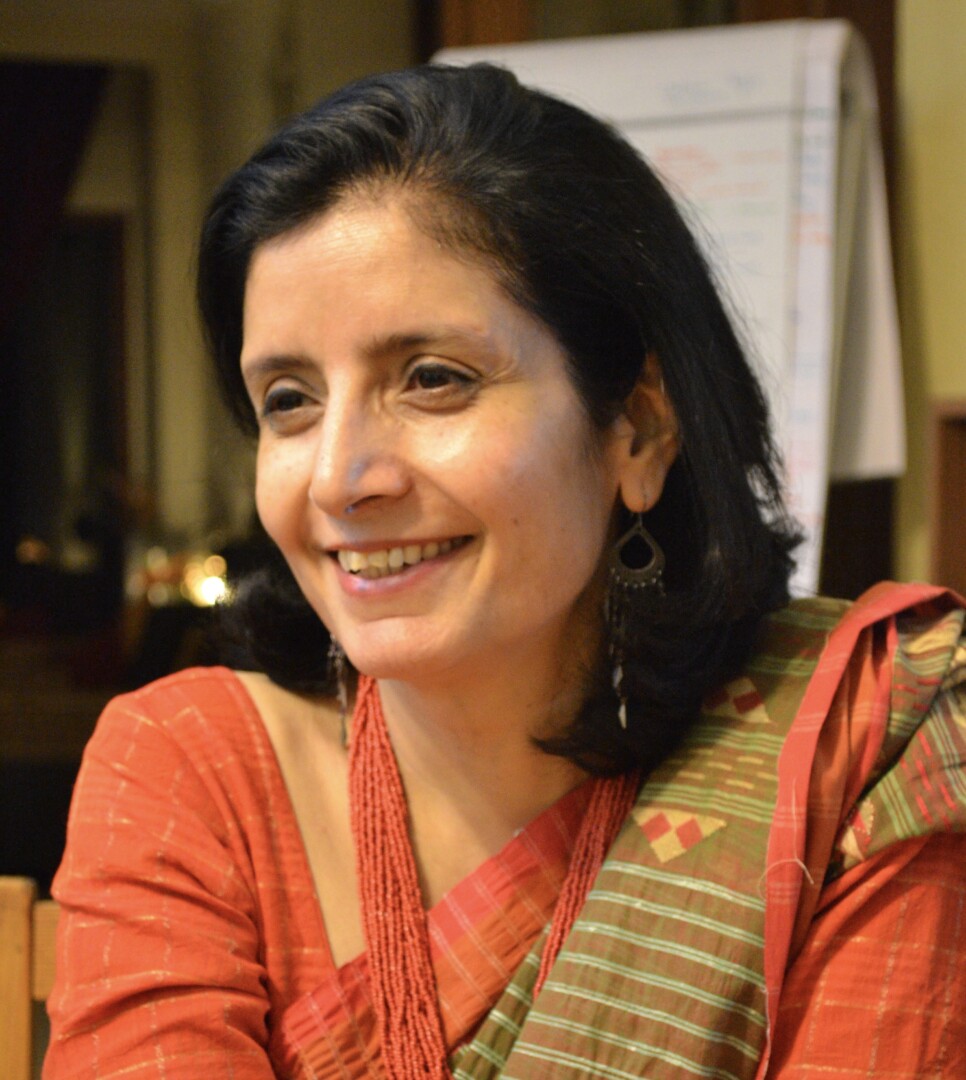 Shelja Sen is narrative therapist, writer and co-founder of Children First, New Delhi. Her latest book is Reclaim Your Life and she is also a columnist with a national newspaper, Indian Express. Shelja has worked as a narrative practitioner and teacher for over 20 years in various contexts in the UK and India. She is an international faculty member at Dulwich Centre Foundation, Adelaide, and a clinical tutor at The University of Melbourne, Australia. Shelja is a curator of the unique skills, expertise and know-how of the children, young people and families she has the honour of working with, and is committed to building innovative, culturally aligned, ethical practices using a feminist intersectional lens.