Protected: From allyship to co-conspiracy: Disentangling psychotherapy from the ally–industrial complex — David Nylund

This article critiques the ways mainstream psychotherapy participates in the “ally–industrial complex”, a term coined by scholars and activists to describe performative allyship that reinforces existing hierarchies. Drawing inspiration from G. Patterson’s (2018) critique of cisgender scholars in transgender studies, I explore how psychotherapy – particularly as practiced by cisgender therapists – often recentres professional authority and individual virtue while masking the field’s complicity in trans and queer marginalisation.

Enter your password to view comments.

Protected: Sustaining the good man — Janet Pelly

This article is written as a companion to “Discovering the good man: Double-story development with a survivor of repetitive ongoing trauma in immigration detention” (Pelly, 2019). While the earlier paper explored double-story development within continuous detention, this article examines what becomes of re-authored identity when detention recurs after a period of relative freedom.

Enter your password to view comments.

Protected: Mothers who move — Jess Baker

When women are forcibly displaced, structurally violent migration processes can have dramatic and devastating effects on experiences of motherhood. This paper shares stories of two women who overcame narratives of shame and guilt, individually developed second stories of motherhood, and then came together through letter writing and narrative conversations to collectively create a renewed sense of belonging.

Enter your password to view comments.

Protected: Inheritance beyond genes — Ximena Karmy Saieg

Many qualities that may be considered “genetic” are, in fact, inherited through stories and the ways they are narrated and re-narrated. This article describes therapeutic conversations with a heterosexual couple who had recently confronted a medical diagnosis of male infertility. Grounded in a relational understanding of identity and using the couple’s Tree of Life, I illustrate how fertile ground was generated for the identity of a child conceived through sperm donation.

Enter your password to view comments.

Protected: Linking lives through collective song creation — Sara Portnoy, Mieke Van Daele and James McParland

This article describes a creative narrative practice using music and song. It draws on collective narrative practice, rescued speech, and poetic and collective documentation, and fuses these with musical performance to create a new practice: collective narrative song creation.

Enter your password to view comments.

Protected: Dismantling dominant disability discourse — Dana Kabaila

Narrative therapy offers powerful approaches for honouring neurodivergent insider knowledge to resist thin, pathologising conclusions. To explore and extend these approaches, I interviewed loved ones as neurodivergent co-researchers using narrative principles to re-dignify their living experience.

Enter your password to view comments.

Protected: Moving beyond the limits of grief — Helene Grau Kristensen and Augusta-Lucia Grau Kristensen

Western grief discourse remains shaped by modernist norms that individualise and internalise struggles with grief. This article proposes that grief-related symptoms often reflect resistance to cultural expectations that the bereaved should “let go” of the deceased and confine them to a static “museum of memories”. We argue that re-membering a deceased child – actively restoring their presence in the ongoing life of the parent – plays a vital role in supporting bereaved parents.

Enter your password to view comments.

Protected: Rebuilding community after collective trauma — Adelite Mukamana interviewed by Nadia d’Or

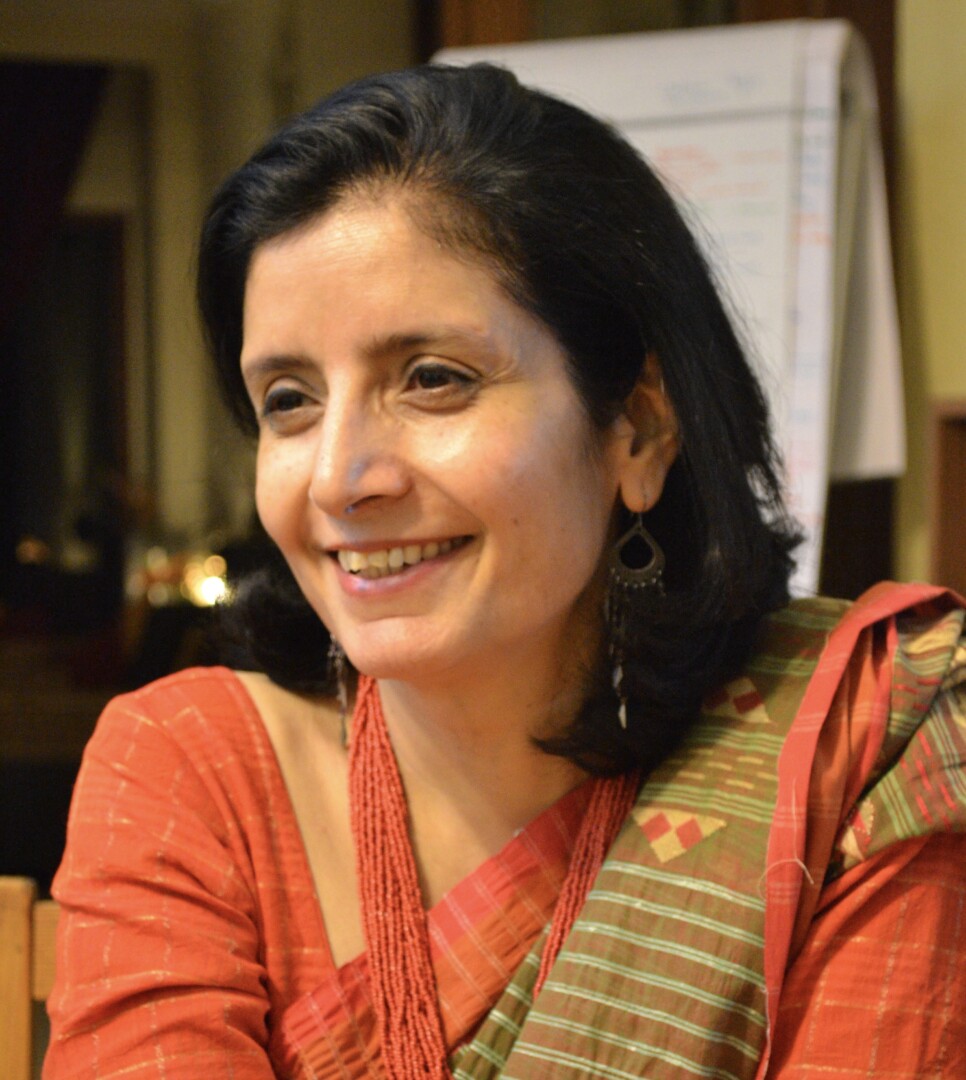
Adelite Mukamana (click for bio) Adelite Mukamana is a clinical psychologist and genocide studies scholar with more than 20 years’ experience in mental health, psychosocial support and peacebuilding. A survivor of the 1994 genocide against the Tutsi, she brings…

Enter your password to view comments.

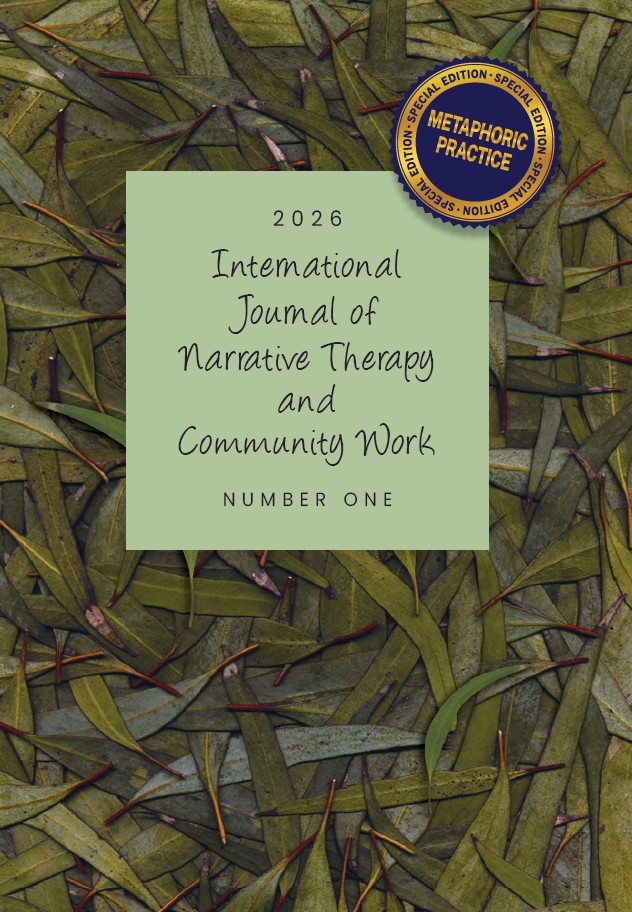
2026: Issue 1 International Journal of Narrative Therapy and Community Work

We've just published a new issue of the International Journal of Narrative Therapy and Community Work. This is a special issue which honours 20 years of the Tree of Life narrative approach. Practitioners in communities across the globe have adapted and expanded this metaphor, finding ways to gather stories of survival, kinship and hope in the face of storms.

0 Comments

“In our own words”: Privileging unheard voices through theatre and storytelling to support health service staff — Sue Gibbons, Njinga Kankinza, Adam McGuigan, Antonia Kemi Coker, Ayeesha Miah and Naomi Harvey-Read

During the COVID-19 pandemic in 2020, our health psychologists were redeployed to provide support to staff in our NHS acute trust. We aimed to develop a supportive intervention that was engaging and accessible to all staff. Working with Wake The Beast theatre company, we collected stories from staff about the challenges they were facing and the innovative ways they were managing.

0 Comments

It takes a village to raise a child: community healing for traumatised children and young people with the “Here you, hear me” card game — Kwong Ka Fai and Wong Sau Mui 

This video highlights the crucial role of community participation in supporting traumatised children and young people. Our project focuses on co-creation and community healing, beginning with the collaborative design of a card game developed in partnership with traumatised children and young people along with other community members.

1 Comment

Resisting erasure: How Muslim women in India are responding to hate and hostility — Sara Asfiya Ali 

“Resisting erasure: How Muslim women in India are responding to hate and hostility” is a collective narrative document that brings together the voices of Muslim women living across urban India. The document centres the voices of Muslim women responding to everyday Islamophobia. Through shared stories of childhood, education, family life, work, motherhood, faith and public life, the document highlights the skills, values, knowledges and commitments that Muslim women draw on as they navigate hostility, othering and hate.

0 Comments

Power, not panic: Community organising and narrative practice at a time of anti-immigrant violence — Susan Shaw interviewed by David Denborough 

In this interview with David Denborough, community organiser and narrative therapist Susan Shaw reflects on more than three decades’ work with communities in the United States, exploring the rich connections between narrative practice and community organising.

0 Comments

Reading Charlie Jane Anders’ Never Say You Can’t Survive and Lessons in Magic and Disaster together at a time of rising hostility to trans folks, a review of the books and the process — Tiffany Sostar, Aakhil Lakhani and April Wick 

A group of friends reviews Charlie Jane Anders’ (2021) nonfiction book Never Say You Can’t Survive: How to get through hard times by making up stories and her (2025) novel Lessons in Magic and Disaster, and reflects on the process of reading these books together.

0 Comments

Fire of Life: Yarning about stories of passions, strengths, skills, interests and hobbies of our mob — Kynan Barnes 

This paper presents a narrative practice metaphor called the Fire of Life. It’s been designed to help tell our stories in ways that make them stronger by yarning about the passions, strengths, skills, interests or hobbies of Aboriginal people, along with the problems that we can face.

1 Comment

“Dear Violence”: Using process drama, narrative therapy and collective letters to explore and acknowledge students’ experiences of domestic violence in PNG — Dorothy Wanega and Jane Awi

This article presents preliminary findings of a locally developed research project that combined arts-based research tools and narrative therapy as a response to the effects of domestic violence on the academic performance of school students between the ages of 16 and 19. Students in selected schools from two regions of Papua New Guinea (PNG) participated in the study.

0 Comments

Reflecting on the healing potentials of dialogue: A review of why dialogue does cure: Explaining what makes dialogue unprecedentedly effective in difficult crises by Jaakko Seikkula — Tom Strong 

Open Dialogue (OD) was developed in Finland as a family- and community-based response to psychiatric emergencies. Central to OD’s development have been the conceptual and research contributions of Jaakko Seikkula. I review and reflect on Seikkula’s recent book on OD’s development that shows how dialogic ideas, research, and client and collegial feedback have come to inform OD as he advocates it be currently practiced.

0 Comments

Exploring the meaning of cosplay for adolescents: A narrative approach — Su Ying 

Cosplay has become a popular subculture among teenagers and is prevalent in Hong Kong, yet it is subject to misconceptions and prejudices. The imagined identities formed through cosplay can contribute to the formation of preferred identities. Cosplay can facilitate self-exploration, expression, social connection and the active construction of identity.

0 Comments

Towards a decentred, politically influential, accountable and yet uncertain practice — Kelsi Semeschuk 

A “decentred” therapeutic stance is often seen as one of the hallmarks of narrative practice. But it isn’t always well understood and is interpreted differently by different practitioners. While I was working on my doctoral research with the archive of video recordings of Michael White’s teaching and therapy sessions, I conducted a side project to better understand his approach to decentred practice.

0 Comments

Resilience Wardrobe: An outfit for coping with challenges — Şeydanur Tezcan Özer and Mehmet Dinç 

This practice-based paper introduces “Resilience Wardrobe”, a narrative therapy exercise that uses wardrobe and outfit metaphors to support externalising conversations, concretise emotions through sensory detail, and invite the thickening of preferred identity stories.

0 Comments

Fireworks, a funeral and friendship: Re-membering community at the end of life — Tanya Newman 

This paper shares a joyful practice story about re-membering community at the end of life. A “socially isolated” man was referred for social work support to arrange a will. This task became a rich experience of re-membering community and supporting Colin to craft his own after-death care.

1 Comment

The Marathon of Life: Storytelling for healing and peace building with second-generation survivors of the Hiroshima and Nagasaki atomic bombings — Keiko Tsuzuki

This paper introduces “the Marathon of Life”, a narrative project developed in collaboration with four Hibaku Nisei – second-generation survivors of the Hiroshima and Nagasaki atomic bombings in Japan. Although they did not directly witness the bombings, their lives have been shaped by intergenerational trauma, moral responsibility and enduring histories of silence. Born into the aftermath of the bombings, these individuals became peace activists.

0 Comments

Desired Dreams: Narrative therapy conversations with trauma survivors about the dreams they would like to experience — Muhammed Nurullah Demir and Mehmet Dinç 

This paper introduces the “Desired Dream” practice, an innovative psychotherapy approach based on narrative therapy. It involves conversations about dream content that individuals want to see and imagine, as distinct from dreams that occur spontaneously during sleep.

0 Comments

Walking in virtual forests: Using Minecraft to create digital Trees of Life — Paul Graham 

This article introduces the use of the video game Minecraft to complete the Tree of Life narrative therapy process and discusses new possibilities for practice that the medium creates. This is explored through a story of practice with an individual, with whom the practice provided an alternative to a traditional intake session. I also share a story of practice in a group setting, as a program offered within a school.

1 Comment

Exposing the feeling of “not good enough”: Working with the failure conversations map — Jonaki Arora 

This paper addresses the phenomenon of personal failure and its relationship with modern power. It describes Michael White’s failure conversations map and the underlying narrative practices that support it. It demonstrates the usefulness of the failure conversations map in subverting modern power and generating preferred identity conclusions with a young woman in India.

1 Comment

Che rete che mba´e (“Mi cuerpo es mío” en idioma Guaraní): Ampliando las identidades preferidas de mujeres trabajadoras sexuales, a partir de la organización como lugar de resistencia política y vital — Paola Kolher Salinas 

This paper is in Spanish, with an English abstract. In a context of social and gender inequality, such as that of Paraguay, women's collective organising becomes a space where their identities acquire new meanings. This is especially true for women sex workers, whose identities are constructed within a context of prejudice, discrimination, and stigmatisation.

0 Comments

The Tree of Life Project: Using narrative ideas in work with vulnerable children in Southern Africa [audio from the archive] — Ncazelo Ncube-Mlilo, read by Ncazelo Ncube-Mlilo 

This audio recording of a paper from the archives of International Journal of Narrative Therapy and Community Work describes the use of narrative ideas in work with vulnerable children in Southern Africa. How can the lives of children who have experienced significant losses be responded to in ways that are not retraumatising and that bring to light children’s own skills and knowledge? What sorts of exercises can be used in camps for vulnerable children? How can children be provided with significant experiences that do not separate them from their families, values and cultural norms? This paper describes a creative adaptation of the “Tree of Life” exercise informed by narrative therapy principles and practices.

0 Comments

Children’s problems and children’s solutions: Celebrating the agency of neurodivergent children – Tarang Kaur

Children, particularly those on the neurodivergence spectrum, have historically not been afforded a great degree of power and voice in their own lives. This has significant implications for the therapeutic space, in which the identification of “problems” and interventions to address them may not take the child’s perspective and skills into account. My work seeks to explore children’s views and understandings of their “problems”, as well as the uniquely skilful actions they take in response. In this paper I describe how narrative therapy principles were adapted for children across a wide spectrum of social skills and degrees of access to spoken language to document – in the form of a scrapbook – various experience-near descriptions of children’s problems and children’s solutions. This living document records the skills, values and acts of resistance demonstrated by a community of neurodivergent children, and offers an opportunity to witness this community’s agency and unique insight into their own situations.

0 Comments

We have always been here, we’ve been here before: Responding to ongoing anti-trans fascism and colonisation with history, storytelling, and connection to land and community – Lorraine Grieves

This video contribution highlights the importance of active response and continued resistance – not reaction – to the rise in transmisogyny, anti-trans and racist hate. Lorraine urges all caring adults, helpers and professionals to recognise how colonial, capitalist and white supremacist systems fuel a sense of overwhelm and can create embodied distress, especially for those under attack by these systems.

3 Comments

“Pockets of freedom”: Creating therapeutic spaces as refuges for Black experiences of neurodivergence – Sandra Coral

The influence of Eurocentricism on therapy spaces makes them unsafe for Black people. This is compounded for Black people whose lives are impacted by their neurodivergence, and therapeutic support needs to account for that. This paper demonstrates how integrating the tenets of critical race theory alongside narrative practice can guide therapists and others in helping professions in creating what Makungu Akinyela has called “pockets of freedom”. These are therapeutic environments free from the interpretations and judgements of the dominant culture, and which serve as a refuge for Black people (with neurodivergence) to heal from the effects of colonialism.

0 Comments

Solidarity conversations: A feminist narrative lens on bulimia and abuse – Kassandra Pedersen

Literature often frames bulimia through biomedical models of disease, emphasising biological, psychological and behavioural deficits, and treatments focused on symptom reduction. This paper reimagines so-called “bulimic episodes” as potential acts of testimony or protest against multiple structures of oppression. Drawing on feminist, narrative therapy and anti-oppressive frameworks, I propose an alternative language to bulimic episodes, using the metaphor of tides as a way of redefining bulimia.

6 Comments

Psychedelic-assisted therapy from a narrative therapy perspective: A map for practitioners — Christine Dennstedt

Psychedelic-assisted therapy is currently in its second wave and enjoying a renaissance of sorts. This article describes a narrative therapy–inspired approach to working therapeutically with psychedelics. My intent in writing this paper is to provide a model for how narrative therapy ideas in practice can be applied to the three stages of psychedelic-assisted therapy: preparation, medicine work and integration. In describing this map for practitioners, the rites of passage metaphor, as applied therapeutically by Michael White, is used to outline the phases a person will move through in their psychedelic-assisted therapy journey.

0 Comments

From isolation to connection: Young people, narrative practice and canine care — Jack Chiu and Sharon Leung

This paper presents a project combining narrative practices and human–canine interaction to support young people in Hong Kong who were socially withdrawn and not in education, employment or training (NEET). Such youth often face societal stigmatisation and isolation. The “We Can” project paired participants with traumatised rescue dogs, fostering mutual healing and reconnection with the young people’s preferred identities and their wider community.

0 Comments

“Love always”: Letters written by dying mothers for their children — Tanya Newman

This article shares stories of dying mothers writing letters for their children. The author conceives of letter writing as a way for mothers to re-member their preferred identities, and the letters as portals for future re-membering for children. The article includes examples of questions asked in interviews with mothers, the thinking behind the questions, and excerpts from the letters these conversations enabled.

1 Comment

Telling our stories in ways that make us stronger by Aunty Barbara Wingard, read by Jean McMahon

This is an audio recording of a paper that was originally delivered as the opening keynote address at the first International Narrative Therapy and Community Work Conference, which was held in Adelaide from 17 to 19 February 1999. A later version of this paper was published as “Grief: Remember, reflect, reveal” in the 2001 book Telling Our Stories in Ways that Make Us Stronger (edited by Barbara Wingard and Jane Lester).

0 Comments

Exploring narrative therapy and therapeutic letter writing in a genetic counselling context — Stephanie Badman

This paper explores using narrative therapy in a genetic counselling context to support people having predictive genetic testing for neurogenetic conditions. Using case examples, I describe my use of narrative therapy practices in this setting, with a particular focus on therapeutic letter writing. I set out the ideas from narrative therapy that I considered in the development of my letter-writing practice.

0 Comments

Wisdom on living with loneliness – Chelsea Size

This audio practice note describes the generation of a collective document of insider knowledges about living with loneliness with older people living in Eldercare residential aged care homes. In Western societies, older people’s skills, knowledges and values can be treated as irrelevant and obsolete, perhaps especially so for those who are living in residential aged care. Considering the discourses around ageing, frailty and loneliness, this audio note reflects on the operations of modern power and opportunities to address a sense of personal failure in aged care using collective documents.

0 Comments
Read more about the article Fear busting and monster taming: An approach to the fears of young children by Michael White, read by Hamilton Kennedy 
A beautiful golden sunrise bursting through the eucalyptus trees as it rises over a mountain. A river cuts through a deep valley with early morning mist rising up the dense foliage on the sides of the mountain.

Fear busting and monster taming: An approach to the fears of young children by Michael White, read by Hamilton Kennedy 

This is an audio recording of a paper that was originally published in Dulwich Centre Review, a precursor to this journal, in 1985. In this paper, childhood fears are considered within the interactional context of the family. It is argued that the survival and growth of such fears is dependent upon the presence of a "fears life-support system". The details of this life-support system can be derived by an examination of the family members' inadvertent participation with a fears lifestyle. Interventions to disrupt this participation are discussed. These interventions include the introduction of a non-threatening interactional description of the problem and a structured ritual to challenge the fears lifestyle. A case example is given.

0 Comments
Read more about the article Cultivating queer joy: Letter writing campaign — Aaron Patey
Aerial View of Cala Brandinchi, Gallura, Northwestern Sardinia, Italy

Cultivating queer joy: Letter writing campaign — Aaron Patey

This audio practice note describes a letter-writing campaign dedicated to sharing insider knowledges of Queer Joy. Letter-writing campaigns seek to create a context to share community knowledges of care in ways that can be accessed by members of the community of concern. This campaign begins with a queer invitation to allow members of the 2SLGBTQIA+ community in our province to write letters about their experience of cultivating queer joy. These letters are then distributed in sessions if a person is struggling to create queer joy in their life. This audio note reviews the care put into the letter-writing invitations. It includes responses from three letter writers and outlines the effects for both readers and writers. I hope that others can create seeds of queer joy in their lives through listening to how others have traversed, creating their queer joy.

0 Comments
Read more about the article Ingata yúbuzima: The ingata of life – Annonciata Niyibizi Muhayimana 
Coast at Neist point lighthouse, Scotland

Ingata yúbuzima: The ingata of life – Annonciata Niyibizi Muhayimana 

Culturally resonant metaphors can highlight local skills and knowledges and strengthen connections to community, culture and history in ways that can sustain us in difficult times. In this video, Annonciata Niyibizi Muhayimana shows how collective narrative practices like the Tree of Life and Team of Life can be adapted to celebrate local cultures. Annonciata introduces the metaphor of Ingata Yúbuzima, the Ingata of Life, a Rwandan metaphor based on the handmade rings used to carry a load on one’s head. The ingata is a treasured item in everyday use, offering protection to those carrying a heavy load. It can be used with assistance and when help is not available. Annonciata shows how she elicited the knowledge of the mothers she worked with about making, using and caring for ingata, and how this local knowledge became the basis for rich metaphors about values, skills, hopes and connection. Individual ingatas were created as a record of what the women wanted to protect, and a giant collective ingata wove their stories together. Ingata Yúbuzima offers a resonant image of protection formed from everyday materials that enables people to skilfully bear weight without being hurt by it. This video is an extract from a presentation that was part of Annonciata’s completion of the Master of Narrative Therapy and Community Work at The University of Melbourne.

6 Comments
Read more about the article Threads of identity: Using fashion and narrative practice to explore preferred stories within the queer community — Libby Olson
Grass Tree overlooking Stirling Ranges near Albany in Western Australia

Threads of identity: Using fashion and narrative practice to explore preferred stories within the queer community — Libby Olson

This video explores the intersection of narrative therapy, fashion and gender identity through the co-creation of a gender-neutral paper doll dress-up game. Drawing from narrative therapy principles, it challenges the rigid gender norms historically reinforced by fashion games, offering a playful yet meaningful tool for identity exploration. Alongside the game, a community collective document is being created to amplify queer voices, sharing stories of resilience and resistance against dominant societal discourses. By integrating creative mediums into therapeutic practice, I examine how narrative therapy can help individuals shape and express their preferred stories.

1 Comment
Read more about the article Staying alive to prove them wrong: Collaborating with trans people, drag performers and queers in contexts of alt-right violence – Belial B’Zarr and Frankie Hanman-Siegersma 
meadow of wild flowers

Staying alive to prove them wrong: Collaborating with trans people, drag performers and queers in contexts of alt-right violence – Belial B’Zarr and Frankie Hanman-Siegersma 

In recent years, we have seen a rise in anti-LGBTIQ+ violence and hate across the settler colonies of so-called Australia, Aotearoa New Zealand and Turtle Island North America. This video interview describes a response to anti-trans and anti-drag hate. It spotlights an individual therapeutic exchange that grew into a web of collective care, action and activism. In the context of counselling, people’s responses to discriminatory violence are often pathologised, creating contexts of blame and shame for people who are living through oppression. This video conversation retells significant fragments of a therapeutic relationship. It includes collective narrative practices such as letter writing, externalising and deconstructing the effects of doxing. We invite practitioners to reflect on how we might take our practices from the therapy room to the streets for protest and collective action, and to stages for drag, cabaret and performance art, as we take up our solidarity with targeted groups.

0 Comments
Read more about the article Researching delusions: A search for epistemic justice, Hamilton Kennedy interviewed by David Denborough
Dry autumn leaves floating on a water surface of a lake.

Researching delusions: A search for epistemic justice, Hamilton Kennedy interviewed by David Denborough

In 2024, this journal published a paper by Hamilton Kennedy highlighting the dismissive responses often experienced by people who hold beliefs that have been labelled as delusional. Hamilton argued that this dismissal constitutes a form of epistemic injustice. We received a number of responses to this article, and decided to interview the author about the wider research project they are engaged in. Hamilton has developed innovative qualitative research methods to explore the history and meanings of beliefs that have been labelled as “delusions”, and to collaborate with research participants in non-pathologising ways. In this interview with David Denborough, Hamilton reflects on some of the practical and ethical considerations involved in conducting research with people whose beliefs have been labelled delusional. They set out how their approach differs from much research in psychiatric contexts, favouring a stance of solidarity, care and reciprocal trust.

0 Comments
Read more about the article Full Circle: Documenting hard-won knowledges and celebrating “bits of brilliance” — KJ Wiseheart
Shot in Chiba,Japan.

Full Circle: Documenting hard-won knowledges and celebrating “bits of brilliance” — KJ Wiseheart

Therapeutic documents can serve as lasting records of the skills and knowledges that have helped people through hard times. When shared, they can foster community and solidarity by challenging limiting narratives and making space for counter-narratives to be seen, heard and celebrated. This practice story describes the creation of a therapeutic document in the form of a short animation, which was developed through narrative therapy sessions with Felicity, an Autistic woman and parent of two Autistic daughters. It shows how an apparently small moment can contain “bits of brilliance” that can become the basis of a significant counter-story.

3 Comments
Read more about the article A narrative family therapy story: Unearthing slugs for the benefit of family healing — Shannon McIntosh
Autumn Mountains at Sunrise Great Smoky Mountains National Park , Tennessee MORE AUTUMN NATURE[url=http://www.istockphoto.com/search/lightbox/4751482] [IMG]http://www.istockphoto.com//file_thumbview_approve/9617101/1/istockphoto_9617101-colorado-snow-capped-peak.jpg[/IMG] [IMG]http://www.istockphoto.com//file_thumbview_approve/5243503/1/istockphoto_5243503-snow-geese-in-flight.jpg[/IMG] [IMG]http://www.istockphoto.com//file_thumbview_approve/10891727/1/istockphoto_10891727-autumn-aspen-and-colorado-mountains.jpg[/IMG] [/URL]

A narrative family therapy story: Unearthing slugs for the benefit of family healing — Shannon McIntosh

“The Terminator” was tricking 11-year-old Nathan into aggression, self-harm and suicidal thoughts. Nathan’s parents wanted to find ways to support Nathan and to develop their own coping skills. This practice story shows how we drew on Nathan’s particular interest in slugs to help him remember preferred ways of being and to keep everyone safe.

0 Comments
Read more about the article Walking forward with uncertainty: A narrative family therapy practice story — Tamara Wilson
Aerial view of tidal dunes and water inlet Shark Bay Western Australia taken from a small plane

Walking forward with uncertainty: A narrative family therapy practice story — Tamara Wilson

This paper shares a story of practice with a family who initially came to counselling because the 17-year-old son was suicidal. Our work came to focus on the family as a whole and their process of coming back together after being separated for some years in response to the father’s drug use. We developed a new understanding of the mother’s decision to ask the father to leave the family home as an act of bravery that had contributed to the wellbeing of all involved. Through identifying individual and collective wonderfulnesses, the family members developed a new shared identity in which bravery, resilience and calm could provide a foundation for responding to current and future life challenges.

0 Comments

End of content

No more pages to load