Editorial by Shelja Sen
Dear Reader
I am writing from Delhi, India, where we have been witnessing young people lead collective action against injustices in this country. A recent social movement has been sparked in response to a remark from a prominent figure dismissing young people as “cockroaches”. In a satirical response, they formed the Cockroach Janta Party, a parody of the right-wing ruling party. While initially seeded in social media, this movement soon spilled out on to the streets of Delhi. Like a rhizomatic organism, it started growing underground – horizontally, spreading in multiple directions, sprouting new shoots where the soil is fertile for resistance. From protest grounds, it spread to homes, schools, colleges, public spaces, neighbourhoods and villages through makeshift news crews on the ground. It is unpredictable and persistent, crossing boundaries of class, caste, religion, gender and region. It is standing up to power structures that are unable to find one single centre to suppress despite rampant police brutality. The more these young people are pushed, the more they respond in creative ways. They use tools of resistance that the power structures are not able to quash – their phones record, document and upload injustices for all to see. Their language is of humour, memes, reels, poetry, music, art, dance and street theatre that state power cannot stifle.
I read the drafts of the papers for this journal issue with images of these young people’s protests in my mind.
What struck me most when I visited the protest ground were acts of collective care: people looking out for each other, sharing water, food and a place to rest. A little boy standing at the corner, spraying people with water to keep them cool. A young woman standing in front of us, fanning herself and her friends, and then turning around and fanning us. I felt safe in the thronging gathering, and despite not knowing anyone, I felt I knew everyone.
I experienced a similar knowing while going through all the contributions from the authors in this issue. I have not met the authors of these papers, who are from very diverse contexts, but I experience a synergy with their commitments to honour the responses, skills and local knowledge of those faced with war, genocide, displacement, transphobia and other injustices and hardships. Let me introduce you to the pieces in this journal.
This issue begins, unusually, with video.
“Rebuilding community after collective trauma” is an extraordinary interview (in French with English subtitles) in which genocide survivor and narrative practitioner Adelite Mukamana from Rwanda is interviewed by Nadia d’Or from Haiti. Adelite explains what it takes to rebuild a community in the aftermath of the genocide’s collective trauma through arts, culture and collective narrative approaches. The conversation delves into how we can heal in the face of immense grief so that the next generation does not inherit the suffering and there can be lasting peace.
“Dreaming trans-affirming mental health care into existence” is a video by Tiffany Sostar of a wish list from trans folks. It offers a vision of what affirming and supportive mental health care might look like. The author clarifies that it is not meant to be “the truth” of what the trans community needs, but is a living document of experiences to shed light on practices that are unhelpful or actively harmful, shared to reduce harm and isolation for others. This video also includes an unexpected “newsflash” that relates to solidarities between communities.
A series of diverse papers then follows. Jess Baker’s paper, “Mothers who move: Traversing refugee experience, overcoming shame and reclaiming motherhood”, shares stories of two women from diverse contexts who unpack narratives of shame and guilt in the face of being separated from their children due to forced displacement and come together through letter writing and narrative conversations to collectively create a renewed sense of belonging. The paper discusses ways narrative practices can support women to rewrite their identities through themes of survival, the politics of motherhood, their stories of resistance and mothers beyond borders. As a response to this paper, Zahra Stanikzai shares her lived experience as a mother, displaced from her home country and her journey of rebuilding her “village”.
Dana Kabaila’s “Dismantling dominant disability discourse” draws on interviews with neurodivergent co-researchers through letters, outsider witnessing and a listening group to make us question the idea of a singular, correct neurotypical brain – a concept that disproportionately marginalises those furthest from its impossible standard. Dana offers a liberatory vocabulary to uphold “neuro-wild” freedoms, and invites us to be “neuro-wild cultivators” and have conversations on “neuro-taming” and “neuro-rewilding”.
In “Inheritance beyond genes”, Ximena Karmy Saieg deconstructs dominant cultural discourses surrounding fertility, fatherhood, masculinity and genetic inheritance, opening space for co-constructed narratives in which a couple can imagine themselves not as passive recipients of genetic material, but as active creators of a web of meanings, relationships and stories that can be built day by day.
Helene Grau Kristensen and Augusta-Lucia Grau Kristensen, in “Moving beyond the limits of grief”, question the Western grief discourse, shaped by modernist norms, which often asks the bereaved to “let go” and confine the deceased to a static “museum of memories”. Through their tender stories of practice, they invite us to understand how grief responses may reflect resistance to these cultural expectations. The authors propose actively restoring the deceased child’s presence in the parent’s ongoing life via a four-part framework – alternative, ally, augmented reality and audience – offering a counter-narrative to hegemonic notions of mourning.
David Nylund’s “From allyship to co-conspiracy” critiques the “ally–industrial complex” where allyship, complete with the right language and credentials, can function as currency, rewarded for perceived alignment with marginalised trans and queer communities while maintaining power over discourse and practice. The paper calls for co-conspiracy rather than good allyship; for shared risk, decentred expertise and material accountability. It opens up a possibility of a world where co-conspirators do not merely support movements. They organise, disrupt and act alongside.
Janet Pelly’s “Sustaining the good man” extends from her earlier work on double-story development within continuous detention to ask what becomes of re-authored identity when detention recurs after a period of relative freedom. Through experience of caregiving, protective narrowing and collective holding, the paper nudges us to go beyond preferred identity claims so that we can explore what enables those claims to endure when agency and freedom are withdrawn. This paper includes a deeply moving response from Abdul Ghaffar Stanikzai, who also had to flee his country of origin due to life-threatening conditions, on the identity of an asylum seeker.
Sara Portnoy, Mieke Van Daele and James McParland’s “Linking lives through collective narrative song creation” draws on collective narrative practice, rescued speech, and poetic and collective documentation, fusing these with musical performance into a new practice – collective narrative song creation. The authors share the enlivening process of developing a song and invite readers to cross borders into unfamiliar territory and expand their musical biographies. They offer ways to share glittery, sparkling moments of joyfulness and connectedness through songwriting, drawing on a rich history of sustenance and resilience in the face of hardship and injustice.
Two further multimedia pieces conclude this issue.
“Exploring grief and re-membering place” by Valeria Kvasnevska is a tender photo essay on her ongoing relationship with her hometown in Ukraine. Her home might be gone physically, but its presence lingers and heals despite the devastation caused by war. As she reminds us, “Healing, I’ve learnt, isn’t about leaving the past behind. It’s about choosing which parts of our history we want to carry forward, and recognising that the places we loved continue to shape who we are, even when we can no longer stand within their walls or riverbanks.”
Michael White’s classic paper “Saying hullo again” is a delightful audio recording by Hamilton Kennedy. This is one paper we can return to time and time again and find so many gems that can revitalise our life and practice. When we face grief, loss or displacement, Michael’s words and gentle questions can offer rich possibilities for the person to reach back, relocate, and perform lost knowledges so they can reclaim their relationship with the lost loved one and “write” a new story of their lives.
This issue is an invitation for all of us to see ourselves as connected and rooted in rhizomic networks needing to stand up to power structures that brutalise through war, genocide, transphobia, detentions and other ruthless acts of harm. I hope we will keep developing innovative practice through songs, arts, humour and collective gatherings. I hope we will continue to tell our stories in ways that make us stronger and make our shoots travel far.
And here in India, my home, I hope people of my generation will learn from and join with those young people who are showing us new ways to organise and dream and resist.
In solidarity
Shelja Sen
Sen, S. (2026). Editorial. International Journal of Narrative Therapy and Community Work, (2), i–iv. https://doi.org/10.4320/OKIW9406
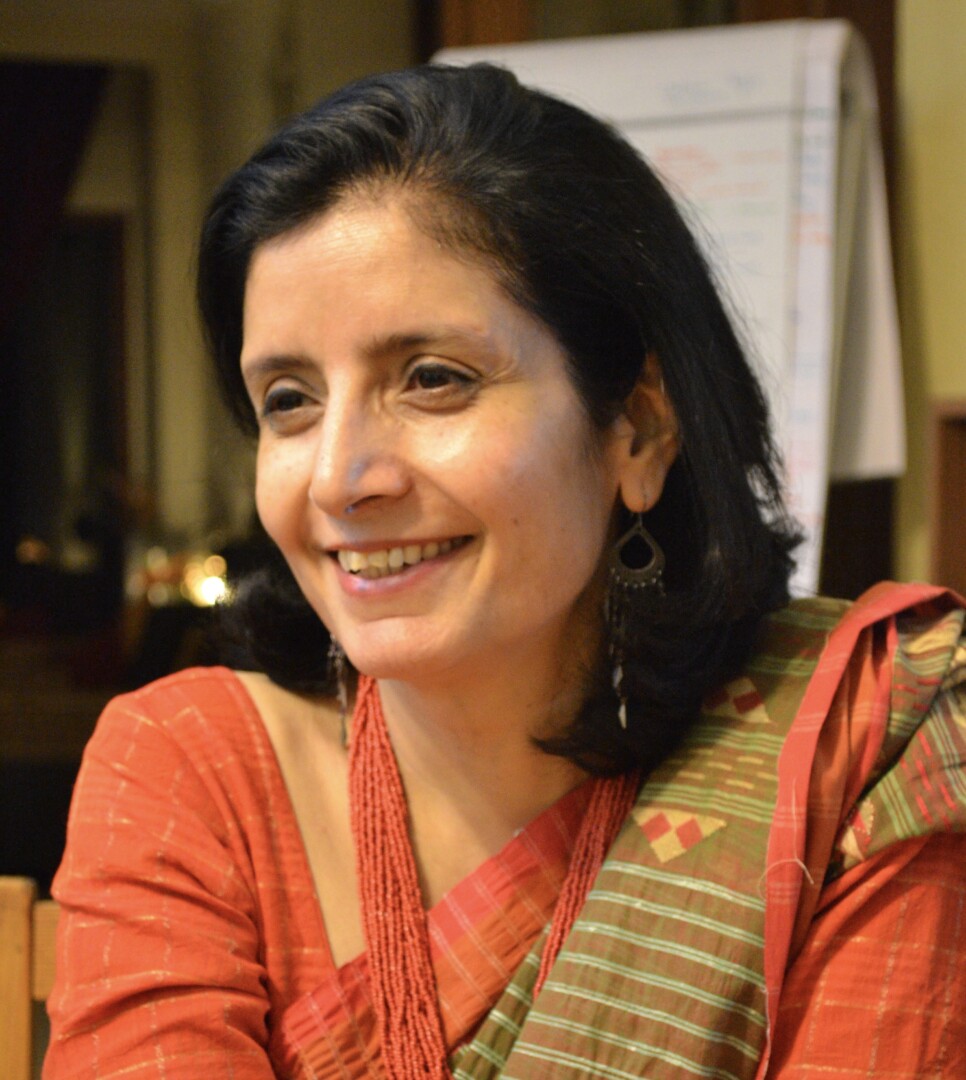 Shelja Sen is narrative therapist, writer and co-founder of Children First, New Delhi. Her latest book is Reclaim Your Life and she is also a columnist with a national newspaper, Indian Express. Shelja has worked as a narrative practitioner and teacher for over 20 years in various contexts in the UK and India. She is an international faculty member at Dulwich Centre Foundation, Adelaide, and a clinical tutor at The University of Melbourne, Australia. Shelja is a curator of the unique skills, expertise and know-how of the children, young people and families she has the honour of working with, and is committed to building innovative, culturally aligned, ethical practices using a feminist intersectional lens.