By Sue Gibbons, Njinga Kankinza, Adam McGuigan, Antonia Kemi Coker, Ayeesha Miah and Naomi Harvey-Read (click for bios)
Dr Sue Gibbons trained as a clinical psychologist (DClinpsych) and systemic psychotherapist in London, UK. She currently works in a London NHS Trust leading the Cancer and Palliative Care Psychology Service, and independently, offering creative supportive interventions to teams and groups. Sue spent 10 years living and working in Zambia, where she learnt a vast amount and was involved in developing theatre and storytelling approaches to supporting young people and adults living with HIV. Sue has a passion for depathologising normality, for combining psychology and the arts, and for finding creative ways to make psychology accessible to everyone. [email protected] www.suegibbons.net
Dr Njinga Kankinza is a UK licensed clinical psychologist in possession of bachelors and honours degrees in psychology from the University of Pretoria in South Africa and a doctorate in clinical psychology from the University College of London (UCL). She is passionate about mental health and wellbeing. She has provided mental health services to individuals and groups presenting with various mental health challenges at a local and international level. Njinga currently works as a stress counsellor for the United Nations staff in Kabul, Afghanistan. Prior to joining this team, she was dedicated to supporting London’s Whittington Health NHS Trust staff in response to the COVID-19 pandemic. The other roles she has held include as researcher and lecturer teaching psychology to undergraduate medical and nursing students. Aside from work, Dr Kankinza enjoys cooking, spending time with family, travelling and taking photos.
Adam McGuigan is a theatre- and filmmaker, and artistic director of Wake The Beast.
Antonia Kemi Coker has over 30 years’ experience as an actor, singer and dancer working nationally and internationally in theatre, film, TV radio as well as forum, street and site-specific theatre. She is passionate about theatre and all other art forms for social and political change aimed at the better for all. She very much welcomed the opportunity to work with London’s Whittington Health NHS Trust staff during the COVID 19 pandemic, having the opportunity to interview, listen to, perform for and discuss their experiences of this time. She recently took part in a play called “Aunting” for The Falmouth International Arts Festival in Cornwall, a Beyond Face Production. In her spare time, Kemi enjoys city and forest walking, water aerobics, percussion, tai chi and qi gong.
Ayeesha Miah (BSc, MSc, PGCert) is a BABCP-accredited psychological wellbeing practitioner currently working within North East London NHS Foundation Trust. She is passionate about promoting mental health and wellbeing and is committed to making psychological support more accessible within diverse communities. Ayeesha has a particular interest in facilitating group therapy sessions, where she supports individuals in developing practical tools to manage emotional difficulties in their day-to-day lives. She also hosts a podcast exploring the intersection between mental health and Islam, where she discusses ways to maintain wellbeing using principles of cognitive behavioural therapy while highlighting how Islamic teachings encourage self-care, balance and emotional resilience. Prior to her current role, Ayeesha gained valuable experience in a range of mental health settings. Her previous roles include working as an honorary assistant psychologist, a mental health recovery support worker and a crisis volunteer with Shout UK, supporting individuals experiencing emotional distress. Outside of her professional work, Ayeesha enjoys expressing her creativity through baking and painting. She is also passionate about hiking and exploring new places, with many destinations still to tick off her ever-growing travel bucket list.
Naomi Harvey-Read is a trainee counselling psychologist.
During the COVID-19 pandemic in 2020, our health psychologists were redeployed to provide support to staff in our NHS acute trust. We aimed to develop a supportive intervention that was engaging and accessible to all staff. Working with Wake The Beast theatre company, we collected stories from staff about the challenges they were facing and the innovative ways they were managing. Actors translated these stories into powerful and lively performances for groups of staff, portraying both the gravity and the lighter moments. This was followed by psychologists facilitating a reflection with the staff, highlighting that they were not alone in their experiences and sharing their ways of “keeping their heads above water”. Feedback showed that staff felt acknowledged and validated, appreciated the opportunity to receive support and support each other, and valued recognition of systemic issues including racism and staff shortages.
Key words: staff support; wellbeing; theatre; storytelling; creative health; Zambia; COVID-19; narrative therapy; collective narrative practice
Gibbons, S., Kankinza, N., McGuigan, A., Coker, A. K., Miah, A., & Harvey-Read, N. (2026). “In our own words”: Privileging unheard voices through theatre and storytelling to support health-service staff [Multimedia work]. International Journal of Narrative Therapy and Community Work, (1), https://doi.org/10.4320/XEFN5031
Supporting health service staff during COVID-19
In March 2020, COVID arrived full force in the UK. Our clinical health psychology team, comprising around 10 clinical, counselling and trainee psychologists at The Whittington Hospital in London, England, was redeployed to support the hospital and community staff who had suddenly found themselves working in a new and highly challenging context.
We started by reaching out to teams and wards and offering group reflection sessions, one-to-one support, and information about useful support services and resources. The majority of requests for support came only from managers who recognised a need for it. It soon became clear that while some teams took up our offers, the majority of the staff either didn’t know that we existed, were in “survival mode” so didn’t have the time or headspace to even think about support, had little knowledge of what psychology was or how it could be helpful to them, or did not view our offers of support as something applicable to them.
Many staff, such as physiotherapists and speech therapists, had been redeployed to work in intensive care or other teams, and others were frustrated to have to shield and work from home. The day-to-day atmosphere in the hospital was one of determination to do everything possible for patients within an ever-changing context of high pressure, uncertainty and fear.
The need for psychological support was recognised, and we sought ways to make it more relevant, visible and accessible to all staff.
Developing a unique and accessible staff-support intervention
Our cancer psychology team had been working with Wake The Beast Theatre Company since 2018. Together we had developed a psychological support intervention called “The C Factor”, in which an actor performed verbatim stories of people living with cancer, making psychology support more widely accessible to cancer patients. The C Factor won a Macmillan Award for Innovation in 2019, and received excellent feedback from participants, who particularly appreciated the mixture of serious discussion and a warm, playful approach. Having seen what a powerful tool verbatim performance could be in facilitating reflection and discussion, we built on this.
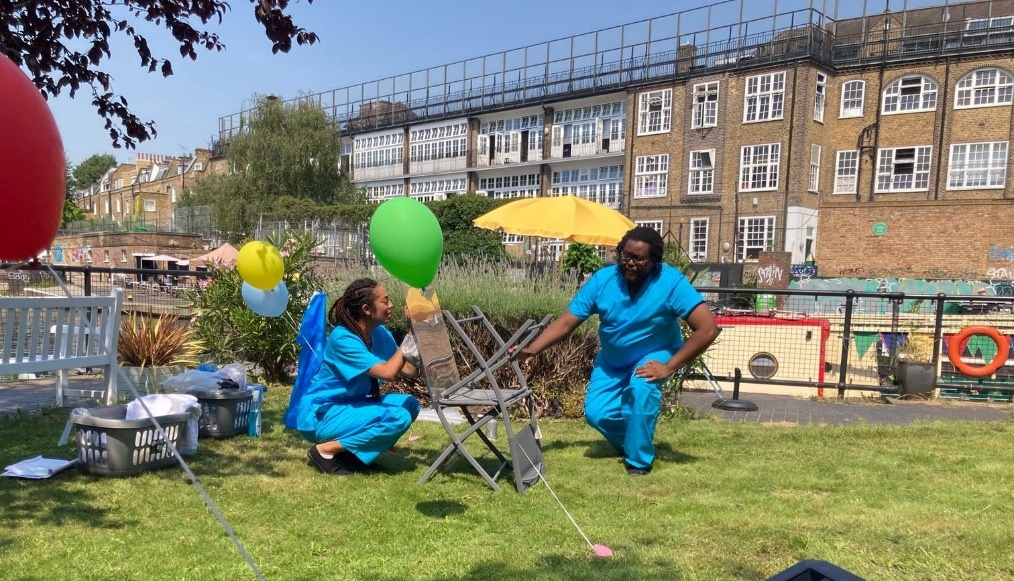
In collaboration with Wake The Beast, we developed a creative staff-support intervention. The aim was to offer a lively and engaging performance of verbatim stories and experiences from a range of staff, followed by a facilitated reflection and discussion about the challenges staff were facing in their work, ways they had found to manage these, and what else might be needed to continue in their work while attending to their own wellbeing.
Inspiration from Zambia
A wealth of experiences and influences informed our development of this approach. A major influence was the cultural context of living and working in Zambia. Psychologist Sue Gibbons met writer and theatre maker Adam McGuigan in Lusaka, Zambia, in 2006, and we began working together on storytelling and theatre projects with young people who had been affected by the HIV/AIDS pandemic. In Zambia, as in many parts of Africa and the world, sharing stories is a cultural way for people to connect, to acknowledge and reflect on experiences, and to pass on learning and wisdom. “Popular theatre” (Mlama, 1991) is also widely used across Africa to facilitate community learning and change, often around health, social and development issues. Back in London in 2020, Adam and Sue were fortunate to find themselves working with psychologist and author Njinga Kankinza, who is of Zambian heritage and was familiar with these concepts. We worked together to develop the intervention further.
A narrative approach
Michael White (2007) coined the term re-authoring. As well as acknowledging the challenges and distress that his clients were bringing, White “double listened” for “exceptions” or “initiatives”, which may form part of a new, more helpful or untold story about ways of managing adversity. We aimed to double listen to our colleagues’ experiences, to witness the challenges they faced while at the same time highlighting the initiatives they took to address the challenges, enabling new stories to be told.
A favourite inspiration has been Aunty Barbara Wingard’s concept of “telling our stories in ways that make us stronger” (Wingard & Lester, 2001). During the COVID-19 pandemic, and since, many staff experienced highly challenging, oppressive, distressing or traumatic situations. We wanted to acknowledge these experiences and to create a space for them to be witnessed (Freedman, 2014) while also shining a spotlight on our colleagues’ many creative and varied responses to these difficult situations.
We wanted to story a sense of agency, to honour the ways that staff found to keep going during difficult times, and to convey that “no one is a passive recipient to trauma” (Yuen, 2009). Yuen looks for even the smallest acts of resistance or caring for oneself or others, enabling a story of agency to emerge.
David Denborough (2008) is an advocate of collective narrative practice, which works with groups or communities and aims to address problems at the social, rather than the individual, level wherever possible. White (1988/89) said “the person is not the problem, the problem is the problem”, and Denborough (2008) added “… and the solution is not only personal”. Once the problem becomes externalised, it is no longer viewed as just the problem of an individual, as in most Western psychiatric and psychological approaches. Instead, we start to look at the problem located within its social context. We aimed to move beyond a focus on individual problems and to address challenges on many levels: individually, within teams, within the NHS Trust and even nationally.
We wanted to tell staff members’ stories in their own ways. The (Draft) Charter of Storytelling Rights (Denborough, 2014) lays out each person’s right to define their own story in their own words and terms. Our theatre pieces use only the exact words spoken by staff in their interviews, and each individual was invited to check the script and give their consent for its use.
Theatre influences
Collaborator Adam McGuigan’s work in Zambia with Barefeet Theatre was particularly driven by participatory process performance or PPP (Mavrocordatos, 2004). PPP draws together a range of theatre for development and participatory research methods and aims to develop campaigns or interventions with groups or communities “from the ground up”. Other inspirations included the methodologies of playback theatre and forum theatre. These approaches went on to influence Adam’s work with Wake The Beast and the creation of The C Factor and In Our Own Words.
Compassionate and inclusive leadership
If we are to be compassionate and inclusive leaders in the NHS, as advocated by West (2021), he urges that we cannot ignore the traumatic, oppressive or disturbing experiences that staff have been through, particularly, but not only, during the COVID pandemic. Not only because we want to show compassion, but also because we know that compassionate cultures lead to improved patient safety, lower patient mortality, less staff burnout, fewer complaints and increased levels of trust between staff and patients (West, 2021).
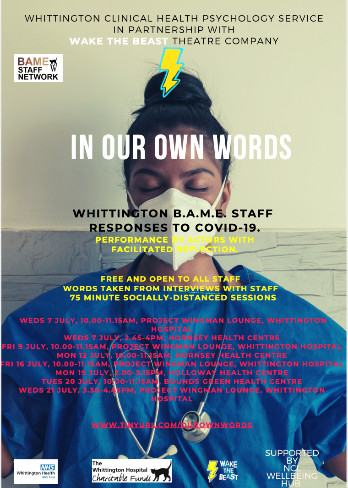
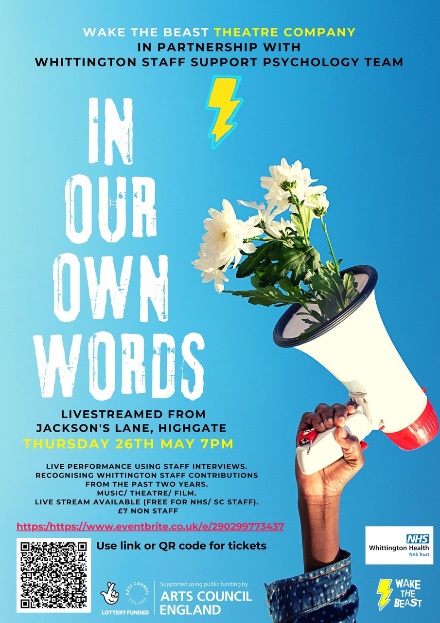
Posters advertising the performances for staff
Watch the full 60-minute performance of “In Our Own Words”
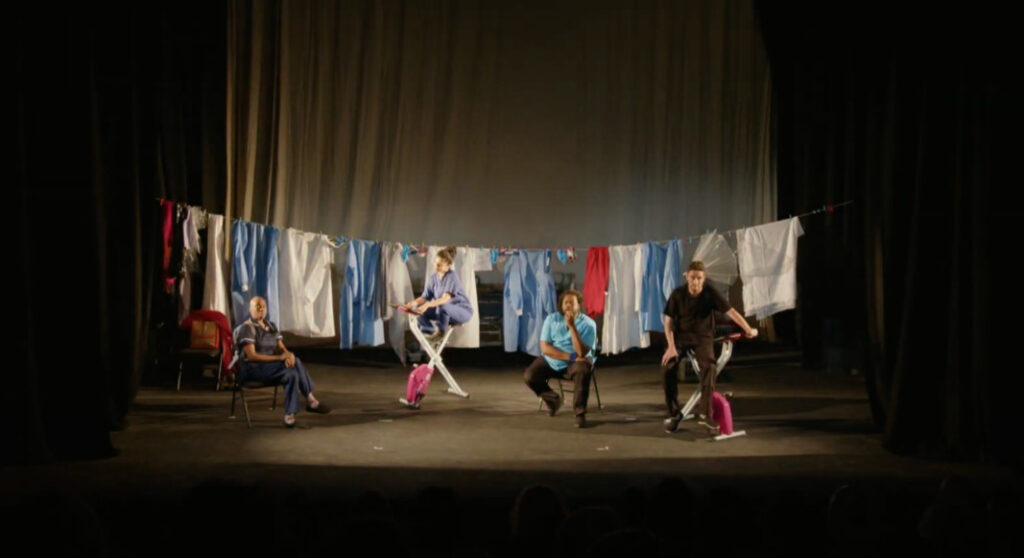
This performance was staged by Wake The Beast Theatre Company in London in May 2022 for NHS and Social Care staff and their friends and families. The performance was followed by a lively Q and A and discussion.
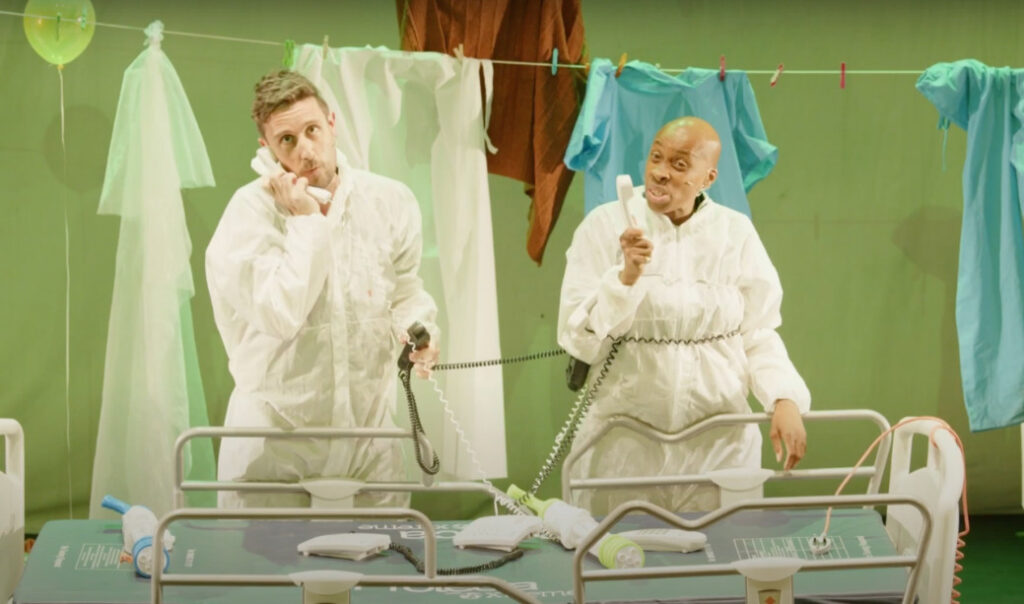
Actors performed each piece with support of a stage manager. A portable stage set, music, background sound and some (voluntary) audience participation created an exciting and theatrical ambiance. The performance took the audience on a journey through a wide range of stories from many different contexts. Stories used staff members’ own words and were warm, playful, surprising, enlightening, at times hilarious, and at times shocking and distressing. Following the performance, psychologists facilitated a reflection with staff.
Responses from staff who told their stories for the project
I could relate to much of what was portrayed in the performance. It felt a therapeutic relief to have many of my feelings and experiences acknowledged. (Participant feedback)
In Our Own Words provided a unique space for staff members to speak up about issues large and small affecting their wellbeing. As experiences were to be conveyed anonymously by actors, staff could speak freely, with no fear of reprisal, allowing their experiences and responses to be witnessed by their colleagues, managers and executives. This was particularly the case for staff from systemically marginalised groups, including staff from Global Majority communities, LGBTQIA+ staff, women, and those on lower bandings and pay scales with less power in the organisation to speak up and be heard.
Article 7 of the (Draft) Charter of Storytelling Rights states that:
Everyone has the right to experience their own learning making a contribution to the lives of others in similar situations.
Many people told us how powerful they found it to see and hear their stories being told. When staff who had been interviewed attended a performance and witnessed their words being spoken by actors, many were visibly moved. In addition, they witnessed the responses of their colleagues and were often surprised and moved by the levels of empathy and shared experiences. One clinician described her experience as becoming part of a bigger story and how that gave her a sense of connection.
It was like my words became a jigsaw piece in a jigsaw puzzle, so then I was able to see them in context of what went before and what went after, and also, how I connected to other people in telling this story. So, there was that interesting thing that I was part of a bigger story …
On seeing her story about patients being treated in the hospital corridors being performed, she reflected:
I feel my anger, a lot of it, is that I think people are trying to sort of not confront that. So to have it up there and brought to life, I felt I had been able to give a voice to that anger, and maybe I felt I’d given a voice to all those people who are left stuck in the corridor … We’re not really allowing them a voice. So yeah. But I felt satisfied with that. … I mean it’s really important, isn’t it, to be able to do something with your anger. So you’re not just sitting with it and you’re not just alone with it.
This story, and her anger about the situation, had previously gone unheard, despite the clinician’s best efforts. Through the performance, her words and emotions and those of the “voiceless” patients were heard and acknowledged. She described no longer feeling alone with it, providing further support for this collective approach.
Space for reflection
Staff participating in the project said they found the facilitated reflection space that followed the performance to be helpful and necessary, and asked for more opportunities for this.
The opportunity to discuss and reflect on the challenges of past month, that I have faced difficulty, I feel I can start to heal.
They highlighted the value of colleagues from all backgrounds and teams working together through the pandemic, reflecting together and supporting each other.
Remembering we are stronger together – share our experiences and support each other.
And they emphasised the power of the performance:
I felt as though the performance was incredibly validating of my experiences throughout the pandemic.
Staff appreciated the acknowledgment of systemic issues including racism, homophobia, staff shortages and lack of funding.
Thank you for mentioning racism because I have been called a servant while working in dentistry and that has never been my job role.
Combining psychology and creative theatre
“Art is a wound turned into light” (attributed to Georges Braque)
One participant commented that despite the vast range of emotions many staff experience in a single shift – connection, fear, joy, anger – these are rarely acknowledged. The performance gave voice to these emotions, and the reflection created a space where they could be “legitimately” discussed. Emotional responses to the work, such as moral injury (Dean et al., 2019), could be named and reflected on.
The playfulness of theatre brought a lighter touch to some intense stories and reached the audience on a range of levels: through words, movement, music and sounds. It brought creativity and made space for appreciation and laughter. We recorded participants’ laughter across a number of the performances, and these ranged between 6 and 17 “laughter episodes” per 35 minute performance.
Many western psychology interventions are experienced by some as dry, anxiety provoking or even intimidating, whereas participants reported finding this approach to be relaxed, accessible and enjoyable.
The actors’ performance quality along with the background music really gave me chills and immediately made me feel like I was living the situation right at this moment. The dynamism and use of different methods (recording, actors, music) really made this an intense and wonderful experience. (Participant feedback)
Working with a consistent theatre company was also key, as both the psychology team and the staff built a trusting relationship with Wake The Beast. The actors conducted the majority of the interviews with staff and were present in the trust for over two years. This combined with impartiality as independent observers on the health service, allowed staff to speak freely with them and for trust to build over time, enabling richer stories to emerge.
Privileging unheard voices
Here’s who I am. I want you to treat me as the director of operations for this division. Not because I’m Black. When I walk into a room, you see my skin first. Don’t make a judgement based on that initially. You need to get to know me first. And that’s all I ask. (Excerpt from In Our Own Words performance)
Some of the performances focused on experiences of specific groups such as staff from Global Majority backgrounds or staff working in care homes.
This allowed some of the stories of members of marginalised groups to be spoken about openly and recognised as shared – not individual – experiences. It brought the unheard stories of some marginalised communities of staff to the attention of the wider group to be witnessed and acknowledged.
When they were talking about racism ... I understand more now about this, and I feel ashamed. it shouldn’t happen in this century. (Participant feedback)
Staff who – for many reasons, including structural racism within our society and the health service – may be unable to speak out about issues affecting them in their day-to-day work, were able to speak anonymously to the independent theatre company. To enable this, the interviews and the writing for the Global Majority staff performances were conducted by members of Wake The Beast Theatre Company with Global Majority heritage.
I am thinking I might not wait to start having conversations with the team. I am a person to speak up a lot after today, more confident to do so. (Participant feedback from Global Majority staff performances)
The development of the performance also led to valued connections and collaboration with the BAME Staff Network (for Black, Asian and minority ethnic staff – as it was then named), and the “See ME First” Team (an initiative to improve inclusivity, equality and diversity; see Mills et al., 2020), who supported the project with their encouragement, ideas and feedback, and through promoting the performances among their networks and beyond.
By inviting decision makers in the organisation to the interventions, they were able to hear staff members’ experiences in a safe space, with room for processing and discussion. There was space to understand many of the shared challenges and solutions, and the possibility for change to be initiated as a result.
Acknowledgments
With grateful thanks for support with the project and the article to:
- The Arts Council of England for funding contribution towards writing this article
- Members of Wake The Beast Theatre Company
- The young people, our Zambian colleagues, Barefeet Theatre and the culture of Zambia, which taught and inspired us
- The many remarkable staff of Whittington Health NHS Trust who so generously gave their stories
- Whittington Health NHS Trust and Whittington Health Charity
- Members of the Narrative Developments Group and Charlotte Burck for invaluable discussion, feedback and editing support.
References
Dean, W., Talbot, S., & Dean, A. (2019). Reframing clinician distress: Moral injury not burnout. Federal Practitioner, 36(9), 400–402.
Denborough, D. (2008). Collective narrative practice: Responding to individuals, groups and communities who have experienced trauma. Dulwich Centre Publications.
Denborough, D. (2014). Retelling the stories of our lives: Everyday narrative therapy to draw inspiration and transform experience. Norton.
Freedman, J. (2014). Witnessing and positioning: Structuring narrative therapy with families and couples. International Journal of Narrative Therapy and Community Work, (1), 11–17.
Mavrocordatos, A. (2004). Crossing over into reality. Footsteps: Theatre for Development, (58), 5.
Mills, D., Senior, B., & Attwal, P. (2020). See ME First Toolkit. Whittington Hospital. https://collection.sciencemuseumgroup.org.uk/objects/co9025352/see-me-first-toolkit-booklet.
Mlama, P. M. (1991). Culture and Development, The Popular Theatre Approach in Africa. Nordiska Afrikainstitutet (The Scandanavian Institute of African Studies), Uppsala.
West, M. A. (2021). Compassionate Leadership: Sustaining wisdom, humanity and presence in health and social care. United Kingdom: The Swirling Leaf Press.
White, M. (1988/89). Externalising the problem. Dulwich Centre Newsletter, Summer. Reprinted in White, M. & Epston, D. (1990), Narrative means to therapeutic ends. Norton.
White, M. (2007). Maps of narrative practice. Norton.
Wingard B., & Lester, J. (2001). Telling our stories in ways that make us stronger. Dulwich Centre Publications.
Yuen, A. (2009). Less pain, more gain: Explorations of responses versus effects when working with the consequences of trauma. Explorations, (1), 6–16.