Sparkling moments from Michael White’s archive: an online course

Welcome
Welcome to this free online course: ‘Sparkling moments from Michael White’s archive’. This resource is a response to many requests from practitioners in different parts of the world who wish to watch video recordings of Michael White and learn more about this work.
About this course
This course has been organised into two parts. The first section is designed for those who are newer to the field of narrative therapy. It includes Michael sharing stories of his practice, some historical papers and documents, and a video in which he outlines some general assumptions that he held.
While designed with folks new to the field in mind, experienced practitioners, like Manja Visschedijk have expressed:
“I learned new things from both sections. It reminded me that learning never stops, and how my orientation to historical material shifts over time, allowing for both consolidation of what I already know, as well as sparking new understandings.”
The second section considers more complex practice matters and is suitable for those who are already familiar with Michael White’s approach. This section includes video recordings of Michael teaching and sharing stories of his practice alongside extracts from the PhD thesis of Kelsi Semeschuk. Kelsi’s research involved rigorous engagement with Michael White’s video archive and was a collective endeavour involving a range of narrative therapists in different parts of the world.
In her research, as a younger feminist practitioner, Kelsi was determined to approach Michael White’s archive not “as a static thing to solidify the present (or current theory), but as a way of continuously engaging with history in ways that expand or complicate current understandings.” (Semeschuk, 2022, p.232). You can read more about this approach here.
In the second section of this course, you have the chance to explore key complex realms, including:
- De-centred and yet influential practice
- Attending to gender politics and refusing to separate practices of abuse/violence from power;
- Deconstructing dominant masculine culture and addressing men’s violence
- Narrative practice and memory
- Curiosity in contrast to wonder
As you move through the course, you’ll find places to write your comments and reflections and to share stories from your own practice.
Acknowledgements
It would not have been possible to put this course together without the work done by Kelsi (Sassy) Semeschuk and Mark Hayward. It has been curated by David Denborough.
The following practitioners offered rigorous and helpful feedback: Manja Visschedijk, Angela Tsun on-Kee, Mark Hayward, Will Sherwin, Chris Dolman, Emma Highfield, Shelja Sen & Lúcia Helena da Silva Assis.
Reference
Semeschuk, K. F. (2022). The Michael White Archive: New learnings from White’s therapeutic practice in the realms of abuse and trauma [Doctoral dissertation, The University of Melbourne]. Minerva Access. https://hdl.handle.net/11343/326533
New to the work of Michael White?
There are many ways to learn about Michael White’s approach to counselling and what has become narrative therapy and community work. If you are completely new to these ideas, you might first like to first dive into our free ‘what is narrative practice?’ online course which conveys not only key principles and practices but also some of the history of its development, including the key collaboration and friendship between Michael White and David Epston.
It’s also possible to view videos of Michael White’s therapy consultations on this page and in online courses on externalising conversations and re-membering conversations.
There are also four key books that we would recommend:
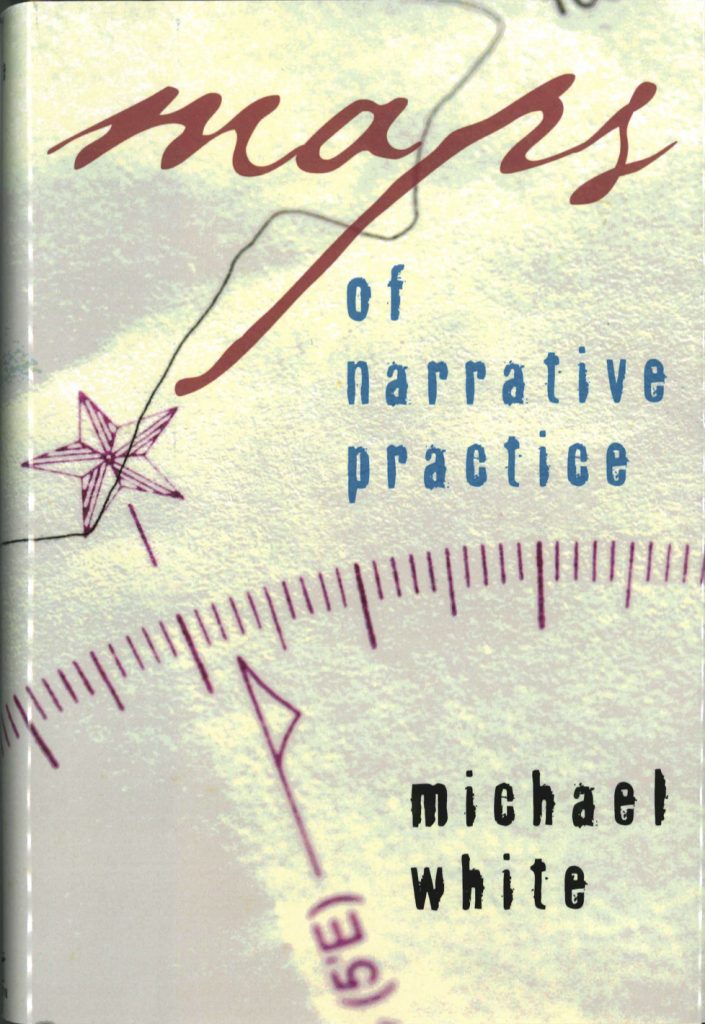
Maps of Narrative Practice
Maps of Narrative Practice by Michael White which vividly conveys the key maps of narrative practice – externalising, re-authoring, re-membering, definitional ceremonies, scaffolding conversations and ways of highlighting unique outcomes. Also available as audiobook. The Maps of Narrative Practice free online course put together by Mark Hayward features demonstrates interviews of these maps.

Narrative Therapy Classics
Narrative therapy classics by Michael White which gathers together papers and interviews by Michael White that transformed conventional notions of therapy, reshaped understandings of psychosis, provided new ways of responding to grief, and continue to profoundly challenge the hegemony of psychiatric knowledges.

Narrative Means to Therapeutic Ends
Narrative means to therapeutic ends by Michael White and David Epston which was the classic early text (1990)
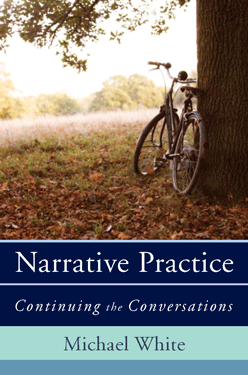
Narrative Practice: Continuing the Conversations
Narrative practice: Continuing the Conversations Published after Michael’s death, this a collection of the work on topics dear to the psychotherapeutic world: turning points in therapy, conversations, resistance and therapist responsibility, couples therapy, and narrative responses to trauma.
Certification module
A certification module is available at the completion of this course.
There will be links to the certification module at the final chapter. You can also find the certification module here.